Tuesday, December 9, 2014

The writing on the doors, sheilas, gals, women

I used to tutor adults in literacy. One of my clients told me that at times he ended up in the women's restroom simply because he didn't recognize the word on the door.


I hadn't given much thought to that until he had mentioned it to me. Most restroom doors do seem to have a silhouette of some type to go along with the text on the door; but apparently not all establishments have done that.

If you see any restrooms that don't have a proper image to go along with their words, be sure to let the management know. Restrooms should be recognizable by all people, whether it is an adult literacy student or by someone from another country.

There are also restrooms that are meant for both men and women; they are usually referred to as family restrooms.

If you own or manage a business that needs an update on restroom signs, you can visit the previous text link to shop on Amazon.

And also, to the best of your ability, work with your students to recognize the various sight words for men and women that are used in your local area.

Cheryl Paton

Cheryl Paton earns income from qualifying purchases made through links on this page.

Monday, October 27, 2014

Consider teaching little words as syllables for the adult student

Most of my adult literacy students had not problem with learning "little" words. They saw it as a foundation for learning bigger words.

But one student in particular already knew a lot of sight words, and didn't make the connection of it being a building block. I think it would have helped if she had thought of them as syllables.

So that might be an approach if you are having a similar situation.

An idea may be to use some of the sight words that the student already knows, and break those down into syllables.

Then you can ask your student if they recognize any of them as being words by themselves; such as cat in the word category.

Cheryl Paton

Monday, September 29, 2014

Improve Literacy - Have your child dictate a story

When children first look at letters, it might look rather foreign to them. However, by writing down something that you child has said, and then read it back to them, makes a stronger connection.

A simple way to do this is to first show the child a picture and ask the child to tell you something about the picture. Then write down each word that the child says, and then read it back to them.


You can also read it again, pointing to each word as you read it.

If you have done a simple outline drawing for the picture, you can also have the child color it in. It helps them to identify with it more, and it also adds an element of fun.

Their early stories will probably be pretty short, maybe two to three words. As the child's vocabulary expands, they will begin to tell longer stories.


These stories can be easily made by adding a photo or drawing a picture on Blank Index Cards,, showing it to the child, and then writing down what they say.

Their stories can be read again and again. My daughter loved sitting down with me to read her stories.

The children's stories, whether short or long, can be placed in pages in mini photo albums. It keeps the pages safe and clean, and makes them more enjoyable to read.

Related Articles
Creative Writing for Kids provides other book ideas to spark your child's creative writing.
Personalized Family Flashcards is a great way to help kids to adults to recognize words that describe family members.

Cheryl Paton

Saturday, July 19, 2014

Alphabet Posters for English

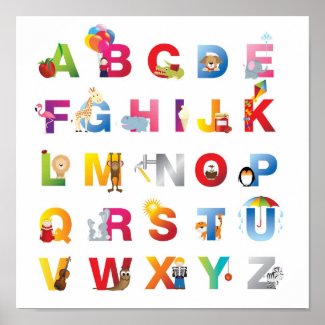
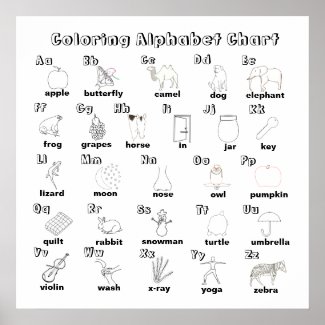
Alphabet posters for kids are a fun way to help reinforce learning of the alphabet. Kids can be attracted by the fun illustrations and colors, and/or they can add their own color on the coloring poster.


For added fun, the kids can color in this one:


Some charts feature blends and digraphs for the more advanced learners.

Learning the alphabet is the basic foundation for learning to read and write. It's great that you're choosing fun ways to incorporate learning in fun ways.

The first two charts above can be ordered from Zazzle.com. The third chart is ready for purchase at Amazon.

If you want this kind of information that isn't shown in such a cute format, for your older students, then check out my book, The Phonics Guide. Common letter patterns, including blends and digraphs, are listed in alphabetical order in the book. The illustrations are simple black and white drawings without all of the cute.

Visit here for alphabet charts illustrated with direction arrows on the letters. You can choose from posters, notepads, and jigsaw puzzles.

Cheryl Paton

C. Paton was a literacy tutor for adults for twelve plus years and is the author of The Phonics Guide: A guide to reading and spelling patterns. Cheryl earns income from qualified purchases made through the links on this page.

Tuesday, April 29, 2014

What are some different ways of spelling the long sound of A?

There are several ways of spelling the long sound of A.

The letter A is a vowel. A by itself can be pronounced as long a, such as, I will go on a hike. The letter a is also a word. The only other letter that is also a vowel and a word, is the letter i.

AI
A common letter pattern for long a, is the letter a, followed by a consonant, followed by a silent e; such as cake, made, grapes, and mate.

The letter pattern AI is also another common spelling for long A; such as train, aim, paid, and grain.

The AI pattern is found in the middle of the syllable or single syllable word.

An exception for the sound is found in the word said, the AI pattern represents the sound of short E in the word said.

Keep in mind that when the AI pattern is immediately followed by the letter R, that the sound is R-controlled. The pattern AIR is also a word when used by itself. It also represents the same sound when used as part of other AIR words, as in hair and fair.

AY
AY is another long A pattern, as in lay, play, stay. and gray.

AY is used mainly at the end of the word or syllable. An exception to this is the word crayon where the A is actually at the end of the first syllable and the Y is the first letter of the next syllable.

EA
EA represents a variety of sounds, one of them is long A, as in break, steak, and great. The EA pattern for long A is found in the middle of the syllable.

EI
The letters EI also represent the sound of long A, as in vein, weigh, weight, and neighbor.

The EI pattern is found in the middle of the syllable

EY
EY can also represent the sound of long A, as in prey and they. EY also represents long E, as in the word, key.

The EY pattern for long A is found at the end of the word or syllable.

You can find this type of information, and more, in The Phonics Guide. If you have found this information helpful, or know someone who would, then you and/or they would probably benefit from reading The Phonics Guide: A guide to reading and spelling patterns. The text link will take you to Amazon where you can order it.

It is not a lesson book, but a reference book, guide, that one can refer to, to look up common spelling patterns, alphabetically.

Cheryl Paton

Cheryl Paton was a literacy tutor for over 12 years. She wrote The Phonics Guide based on the types of questions her adult literacy students were asking her. Cheryl receives income for qualifying items purchased through links on this page.

Tuesday, July 9, 2013

Literacy and Phonetics - Alphabet Shirts

Children learn in a variety of ways. It's a good idea to incorporate different activities when teaching reading. It helps to reinforce the text when there is an activity to connect the reading to, other than just what is visual on the page, or the sound of one's voice.

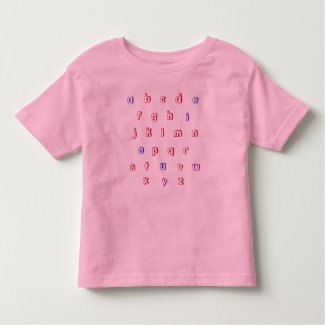
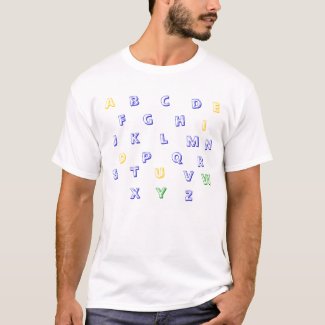
This fun activity involves the kids coloring in letters on a shirt that they can wear.


Of course, they don't have to color in the letters, they can just be fun to read and recite, to learn the order of the alphabet.

If you notice, the alphabet letters are shown in three different colors. The consonants are in red. The vowels are in blue. The crossover letters are in purple. Crossover letters are letters that sometimes act like a consonant, and sometimes like a vowel.

Most people are taught that the letter Y is sometimes a consonant and sometimes a vowel. Now Y has a pal; W.

W is also a crossover letter. The W acts like a consonant in the word - who. The W acts like a vowel, like a silent E in the word - flow.

Y can represent a variety of sounds. Y is a consonant in the word - yellow. Y acts like a long I in the word - fly, and like a long E in the word - baby.

A coloring alphabet shirt is a fun way to reinforce this concept. Teachers can wear alphabet shirts too.


Whether you're ordering a shirt for a teacher and/or student, I recommend acrylic paint markers for fabric. to color them in. The paint markers are quite permanent, and it's pretty simple to apply. Be sure to place a sheet of flat cardboard between the fabric layers before doing any coloring or painting on the shirts.

Happy reading; and coloring.

Cheryl Paton

Cheryl Paton earns income from qualified purchases made through the links on this page.

Literacy and Phonetics - Making Reading Fun for Kids

Part of learning is to make it fun. My daughter loved reading before starting school. She loved being read to and was learning how to sound things out. She had favorite books and looked forward to more. When she started elementary school, the school had a Book It Reading Program. The kids were rewarded for reading a certain number of books, and she loved that too.

Then came a higher grade, and the school wanted the kids to do timed readings. Do you want to be timed while you read? Do you think that would be fun? Well I know that my daughter didn't. She was pretty quick at reading; she had been reading pretty fluently for her grade levels and beyond for a while. But having to be timed, took the fun out of it. Reading became a chore.

After that class was over, she eventually learned to put the fun back in, and began to enjoy reading again. If you have any kids in grades that are doing timed readings, you might want to have a chat with the teacher. It's more important to give kids a reason to read, than to time them. Talk to them a bit about what the book is about. Spark their interest in wanting to find something out. You can do this by asking the child about what they think will happen.

My daughter is has graduated from college now, and recommends that the kids keep a reading journal. The kids read for a block of time and then write a short summary; a couple of sentences about what they've read. She remembers doing this in first grade and enjoying that activity.

Having kids enjoy learning to read as kids, is a great way to create adults who also enjoy to read.

Having the child dictate their own stories is a great way to build reading skills. Find out more on Dictate a Story.

Cheryl Paton